Picture Gallery Kids "R" Us Breeds Availible
Anglo-Nubian:
Other Names: Nubian (USA)
Anglo-Nubians were developed in England by crossing British goats with bucks of African and Indian origin.
The Anglo Nubian is an all-purpose goat, useful for meat, milk and hide production. It is not a heavy milk producer but has a high average butter fat content (between four and five percent). The Anglo Nubian breeding season is much longer than that of the Swiss breeds so it is possible to produce milk year round.
As it is the best suited of the dairy goat breeds to hot conditions, the Anglo Nubian has been used in grading-up programs in many tropical countries to increase the milk and meat production of local breeds.
The Anglo-Nubian is a relatively large, proud, and graceful dairy goat. The Anglo-Nubian goat is named for Nubia, in northeastern Africa. The originally goats imported from Africa, Arabia and India were long-legged, hardy goats that had some characteristics desired by goat breeders in England. English breeders crossed these imported bucks on the common short-haired does of England prior to 1895 to develop the Anglo-Nubian goat. In the United States the breed is usually spoken of as the Nubian.
The Anglo-Nubian is regarded as an "aristocratic" appearing goat and has very long, pendulous ears that hang close to the head. The Anglo-Nubian carries a decidedly Roman nose and is always short-haired.
Any solid or parti-colored coat is permitted in the Anglo-Nubian, but black, red or tan are the most common colors, any of which may be carried on combination with white. Usually there is shorter hair on the Anglo-Nubian males, particularly along the back and on the thigh, than is commonly found on the Swiss breeds.
The udder of the Anglo-Nubian is capacious but is sometimes more pendulous than that of the Swiss breeds. A mature doe should stand at least 30 inches at the withers and weigh 135 pounds or over, while the males should stand at least 35 inches at the withers and weigh at least 175 pounds. The Anglo-Nubian usually gives less milk than the Swiss breeds, but produces a milk of higher butterfat content.
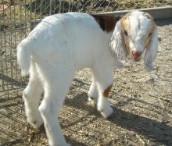
The head is the distinctive breed characteristic, with the facial profile between the eyes and the muzzle being strongly convex. The ears are long (extending at least one inch beyond the muzzle when held flat along the face), wide and pendulous. They lie close to the head at the temple and flare slightly out and well forward at the rounded tip, forming a "bell" shape. The ears are not thick, with the cartilage well defined. The hair is short, fine and glossy.
Any color or colors, solid or patterned, is acceptable.
Boar:
Also Known by: Africander, Afrikaner, South African common goat
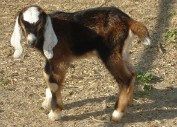
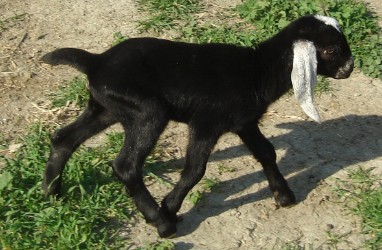
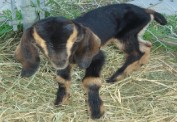
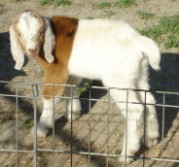
The Boer is an improved indigenous breed with some infusion of European, Angora and Indian goat breeding many years ago. Several researchers agree that the indigenous populations were probably from the Namaqua Hottentots and from southward migrating Bantu tribes. The name is derived from the Dutch word "boer" meaning farmer and was probably used to distinguish the native goats from the Angora goats which were imported into South Africa during the 19th century. The present day Boer goat appeared in the early 1900's when ranchers in the Easter Cape Province started selecting for a meat type goat.
The South African registry was established in 1959. Since 1970 the Boer goat has been incorporated into the National Mutton Sheep and Goat Performance Testing Scheme making it the first goat breed involved in meat production performance testing.
The male goat is called 'buck' and female goat 'doe'. The Boer goat is primarily a meat goat with several adaptations to the region in which it was developed. It is a horned breed with lop ears and showing a variety of color patterns. The Boer goat is being used very effectively in South Africa in combination with cattle due to its browsing ability and limited impact on the grass cover. Producing weaning rates in excess of 160% the Boer goat doe is a low maintenance animal that has sufficient milk to rear a kid that is early maturing. The mature Boer Goat buck weighs between 110-135 kg (~240-300 lbs) and does between 90 and 100 kg (~200-225 lbs).
Performance records for this breed indicate exceptional individuals are capable of average daily gains over 0.44 lb/day (200 g/day) in feedlot. More standard performance would be 0.3-0.4 lbs/day (150-170 g/day). The ovulation rate for Boer goats ranges from 1 to 4 eggs/doe with an average of 1.7. A kidding rate of 200% is common for this breed. Puberty is reached early, ususally about 6 months for the males and 10-12 months for the females. The Boer goat also has an extended breeding season making possible 3 kiddings every 2 years.
Toggenburg:
The Toggenburg is a Swiss dairy goat from Toggenburg Valley of Switzerland at Obertoggenburg. They are also credited as being the oldest known dairy goat breed.
This breed is medium size, sturdy, vigorous, and alert in appearance. Slightly smaller than the other Alpine breeds, the does weight at least 120lb/55kg.
The hair is short or medium in length, soft, fine, and lying flat. Its color is solid varying from light fawn to dark chocolate with no preference for any shade. Distinct white markings are as follows: white ears with dark spot in middle; two white stripes down the face from above each eye to the muzzle; hind legs white from hocks to hooves; forelegs white from knees downward with a dark lien (band) below knee acceptable; a white triangle on either side of the tail; white spot may be present at root of wattles or in that area if no wattles are present. Varying degrees of cream markings instead of pure white acceptable, but not desirable. The ears are erect and carried forward. Facial lines may be dished or straight, never roman.
Toggenburgs perform best in cooler conditions. They are noted for their excellent udder development and high milk production, and have an average fat test of 3.7 percent.
Saanen:
The Saanen dairy goat originated in Switzerland, in the Saanen Valley. Saanen does are heavy milk producers and usually yield 3-4 percent milk fat. It is medium to large in size (weighing approximately 145 lbs/65kg) with rugged bone and plenty of vigor.
Does should be feminine, and not coarse. Saanens are white or light cream in color, with white preferred. Spots on the skin are not discriminated against. Small spots of color on the hair are allowable, but not desirable. The hair should be short and fine, although a fringe over the spine and thighs is often present. Ears should be erect and alertly carried, preferably pointing forward. The face should be straight or dished. A tendency toward a roman nose is discriminated against.
The breed is sensitive to excessive sunlight and performs best in cooler conditions. The provision of shade is essential and tan skin is preferable.
LaMancha:
The LaMancha goat originated in Oregon by Mrs. Eula Frey from short-eared goats of a type found not only in LaMancha, but throughout spain. It has excellent dairy temperament and is an all-around sturdy animal that can withstand a great deal of hardship and still produce. Through official testing this breed has established itself in milk production with high butterfat.
The LaMancha face is straight with the ears being the distinctive breed characteristic. There are two types of LaMancha ears. In does one type of ear has no advantage over the other.
- The "gopher ear" is described as follows: an approximate maximum length of one inch but preferably non-existent and with very little or no cartilage. The end of the ear must be turned up or down. This is the only type of ear which will make buck eligible for registration.
- The "elf ear" is described as follows: an approximate maximum length of two inches is allowed, the end of the ear must be turned up or turned down and cartilage shaping the small ear is allowed.
Any color or combination of colors is acceptable with no preferences. The hair is short, fine and glossy.
Picture coming soon.
Saanen- Nubian mix:
Specially breed for milk production. Producers of large quanity of milk 1 gal per milking. Known for its high fat content. Great for milk and cheese.
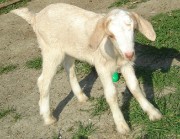
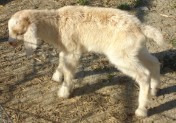
La Mancha- Saanen mix:
Specially breed for milk production. producers of large quanity of milk with a sweet unique taste. Known for its high fat content. Great for milk and cheese.